YouTube Thumbnail Score: 2026 Audit Checklist
YouTube thumbnail score checklist for creators: test clarity, contrast, promise match, mobile crop, AI review, and CTR risk before publishing.
Direct answer
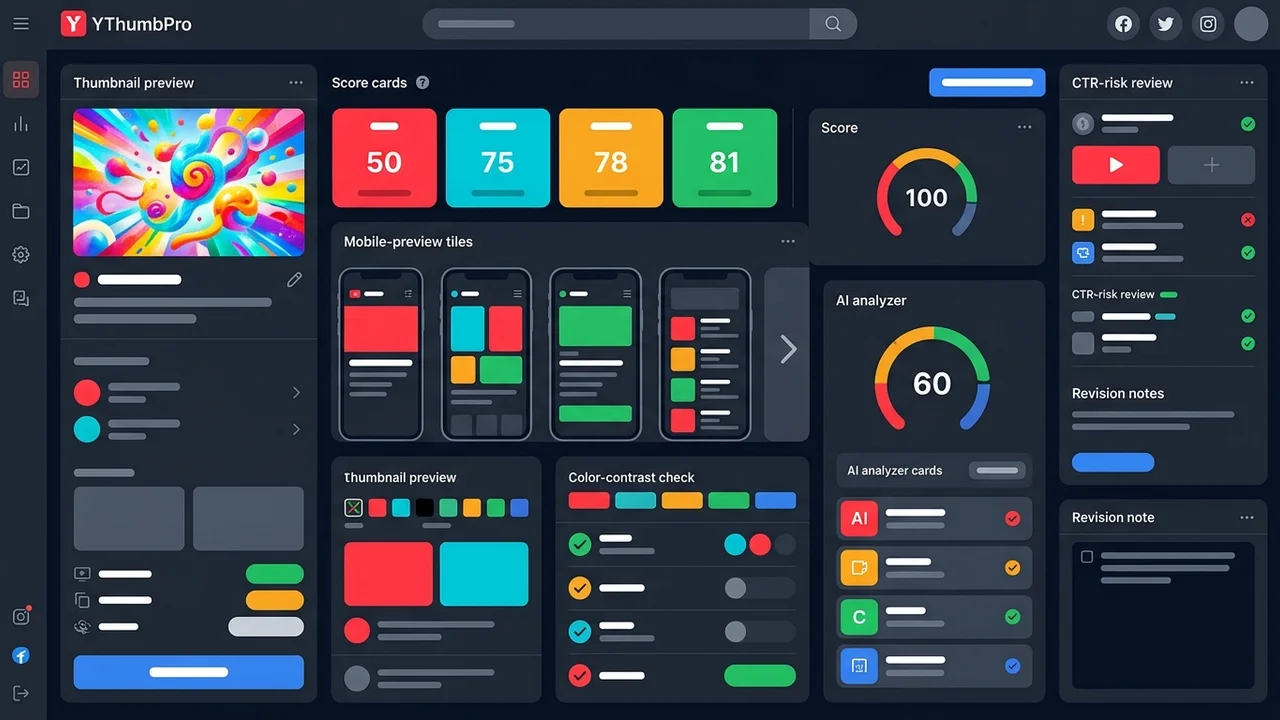
A useful YouTube thumbnail score is not a magic grade. It is a structured audit of mobile readability, focal clarity, contrast, emotional pull, title-thumbnail promise match, originality, policy risk, and click-through testing priority. Use the score to decide what to fix before upload, not to copy another creator's design.
Key takeaways
- Score thumbnails by decision criteria: clarity, contrast, promise match, originality, and test priority.
- Use a thumbnail score before upload, after a low-CTR warning, and when refreshing older videos.
- Treat AI scoring as a reviewer, then confirm the result against mobile crop and audience intent.
- Save score notes with the video title, publish stage, and next action so the audit changes behavior.
Published: 2026-07-07 Last updated: 2026-07-07 Author: jackyi Reviewed by: YThumbPro editorial review
AI-assisted writing disclosure: this article was drafted with AI assistance and reviewed for accuracy, originality, and YThumbPro product fit by the YThumbPro editorial team.
youtube thumbnail score checks are most useful before a creator uploads, not after a video has already lost momentum. A score should translate thumbnail quality into a clear decision: ship it, revise the visual hierarchy, test a second concept, or replace the idea. This guide shares the YThumbPro scoring workflow I use for mobile readability, contrast, promise match, AI review, and CTR risk.
A useful YouTube thumbnail score is not a magic grade. It is a structured audit of mobile readability, focal clarity, contrast, emotional pull, title-thumbnail promise match, originality, policy risk, and click-through testing priority. Use the score to decide what to fix before upload, not to copy another creator's design.
YouTube Thumbnail Score Checklist
A youtube thumbnail score should measure whether the image can win attention and stay honest to the video. I use a scorecard because subjective feedback like "make it pop" is too vague for a creator team.
Start with these criteria:
- Mobile readability: can the main idea be understood at feed size?
- Focal clarity: is there one obvious subject or outcome?
- Contrast: do subject, background, and text separate quickly?
- Promise match: does the thumbnail support the title without misleading?
- Emotional signal: does the image show a reason to care?
- Originality: does it avoid looking like a copied competitor frame?
- Policy and brand risk: is it safe to publish and consistent with the channel?
| Score area | What to inspect | Common fix |
|---|---|---|
| Mobile readability | Subject, text, and visual promise at small size | Crop tighter or remove extra elements |
| Contrast | Color separation and edge clarity | Add brighter subject/background separation |
| Promise match | Thumbnail claim vs video title | Rewrite the title or redesign the visual hook |
| Originality | Similarity to competitor layouts | Change angle, framing, color, or core concept |
| Test priority | Business importance and uncertainty | Create a second variant for A/B review |
The number is only useful if it points to a next action. A 62 with one obvious fix is better than an 84 that nobody understands.
YouTube Thumbnail Rating Signals That Matter
youtube thumbnail rating systems often overvalue polish and undervalue intent. A clean image can still fail if the promise is vague, the subject is too small, or the title says something the thumbnail does not support.
When I review a thumbnail, I separate visual quality from strategic fit. Visual quality asks whether the image is readable. Strategic fit asks whether the image makes the right viewer curious about this exact video.
Use this quick rating scale:
- 90-100: ready to publish, with only minor crop or export checks.
- 75-89: usable, but one clear revision could improve CTR odds.
- 60-74: risky; revise the hook, focal point, or title match before upload.
- Under 60: rebuild the concept or create a second thumbnail direction.
This score should be saved with the video title and review date. That makes it easier to compare the score against actual impressions and CTR later.
YouTube Thumbnail Analyzer Workflow
A youtube thumbnail analyzer helps when the team is too close to the design. It can flag clutter, weak contrast, unreadable text, missing focal hierarchy, and possible title-thumbnail mismatch.
The clean workflow is:
- Upload the draft thumbnail to the YouTube Thumbnail Analyzer.
- Compare the score against your manual checklist.
- Check title alignment in the YouTube Thumbnail CTR Checker.
- Review the scoring logic in How We Score Thumbnails.
- Record one decision: ship, revise, test, or replace.
Do not treat AI output as an absolute answer. Treat it as a fast reviewer that makes weaknesses easier to discuss. For deeper context, the YThumbPro guide on how AI scores thumbnail CTR explains which signals AI can evaluate and which require creator judgment.
When to Rescore a Thumbnail Before Testing
A youtube thumbnail score is most valuable at three moments: before publishing, after a low-CTR warning, and before refreshing an evergreen video.
Before publishing, the score prevents obvious mobile and promise-match problems. After a low-CTR warning, it helps separate thumbnail issues from topic, title, audience, or distribution issues. During an evergreen refresh, it gives the team a consistent way to compare the old thumbnail against new variants.
Use A/B testing only when the decision deserves it. If the thumbnail is clearly unreadable on mobile, fix that first. If two strong concepts both score well, then use the YouTube Thumbnail A/B Testing Guide to structure the experiment.
Score Notes for Competitor and Refresh Reviews
Score notes are more useful than the score alone. For competitor research, use Competitor Thumbnail Analysis or the guide to analyze competitor YouTube thumbnails, then record what the competitor does well without copying the artwork.
For owned-channel refreshes, compare the old thumbnail, current title, top traffic source, and audience expectation. A thumbnail with a moderate score may still be worth keeping if it matches the audience perfectly. A high-scoring redesign may be risky if it changes the promise too aggressively.
Official context matters too. YouTube documents thumbnail requirements in YouTube Help, YouTube Creator Academy covers effective thumbnail practices in its thumbnail lesson, and Google explains image context in Search Central image SEO best practices.
Conclusion
A youtube thumbnail score should turn visual feedback into a publishing decision. Score mobile readability, focal clarity, contrast, promise match, originality, and test priority, then write the next action before the review ends.
Ready to review a draft? Start with the YouTube Thumbnail Analyzer, compare title fit in the CTR checker, or read YThumbPro's scoring methodology.
Frequently Asked Questions
Q: What is a good YouTube thumbnail score?
A good score usually means the thumbnail is readable on mobile, has one clear focal point, matches the title promise, and avoids confusing visual clutter. The exact number matters less than the specific fixes behind it.
Q: Can a YouTube thumbnail analyzer predict CTR?
A YouTube thumbnail analyzer can flag patterns that often affect CTR, such as weak contrast, unclear subjects, or title mismatch. It cannot guarantee performance because audience, topic, search intent, and distribution also shape click-through rate.
Q: Should I use a YouTube thumbnail rating before publishing?
Yes, use a rating before publishing when the video depends on browse or suggested traffic. It helps catch mobile readability and promise-match problems while the thumbnail is still easy to change.
Q: How often should I rescore old thumbnails?
Rescore older thumbnails when a video has impressions but weak CTR, when the title changes, or when the topic becomes newly relevant. A quarterly review is enough for most evergreen libraries.
About the Author
jackyi is a YouTube growth and thumbnail optimization practitioner focused on practical creator workflows. YThumbPro articles are written with AI assistance, edited for originality, and reviewed against product behavior before publication.
Next action
Use this guide on a real YouTube thumbnail
Paste a video URL, download the available thumbnail sizes, then decide whether the image needs a deeper AI readiness review.
Step-by-step guide
- 1
Open the thumbnail in mobile size
Check whether the main subject and promise still read when the image is reduced to a small mobile preview.
- 2
Score the core visual signals
Rate focal clarity, contrast, emotional pull, color separation, text readability, and thumbnail-title match.
- 3
Run AI analysis
Use YThumbPro's analyzer to catch issues a manual review may miss, especially clutter, weak focal hierarchy, and CTR risk.
- 4
Write the next action
Do not stop at a number. Record whether to ship, revise text, crop tighter, change color, test a variant, or replace the concept.
- 5
Review after impressions arrive
Compare the score notes with actual CTR and retention context once the video has enough impressions to learn from.
Frequently asked questions
What is a good YouTube thumbnail score?
A good score usually means the thumbnail is readable on mobile, has one clear focal point, matches the title promise, and avoids confusing visual clutter. The exact number matters less than the specific fixes behind it.
Can a YouTube thumbnail analyzer predict CTR?
A YouTube thumbnail analyzer can flag patterns that often affect CTR, such as weak contrast, unclear subjects, or title mismatch. It cannot guarantee performance because audience, topic, search intent, and distribution also shape click-through rate.
Should I use a YouTube thumbnail rating before publishing?
Yes, use a rating before publishing when the video depends on browse or suggested traffic. It helps catch mobile readability and promise-match problems while the thumbnail is still easy to change.
How often should I rescore old thumbnails?
Rescore older thumbnails when a video has impressions but weak CTR, when the title changes, or when the topic becomes newly relevant. A quarterly review is enough for most evergreen libraries.