How to Analyze Competitor YouTube Thumbnails
A practical competitor thumbnail analysis workflow for identifying category patterns, ethical inspiration, mobile readability, and differentiation opportunities.
Direct answer
To analyze competitor YouTube thumbnails, collect comparable videos, note repeated patterns in framing, text, color, expression, and promise, then decide which principles fit your own channel. Use the pattern, not the copied asset.
Key takeaways
- Review competitors by topic and channel type, not random viral videos.
- Look for repeatable patterns and gaps.
- Ethical analysis adapts principles instead of copying assets.
Competitor thumbnail analysis notes
| What to inspect | Question to ask | Actionable output |
|---|---|---|
| Text | How many words survive mobile? | A text-length rule for your niche |
| Subject | What gets the main focus? | A clearer focal hierarchy |
| Color | Which palettes repeat? | A way to fit or stand out |
| Promise | What curiosity gap is used? | A better title-thumbnail match |
Choose a focused competitor set
The best research set is narrow: same topic, similar audience, and similar video format. Random top videos create noisy lessons.
Collect five to ten thumbnails first. That is enough to see patterns without turning research into procrastination.
Separate pattern from copying
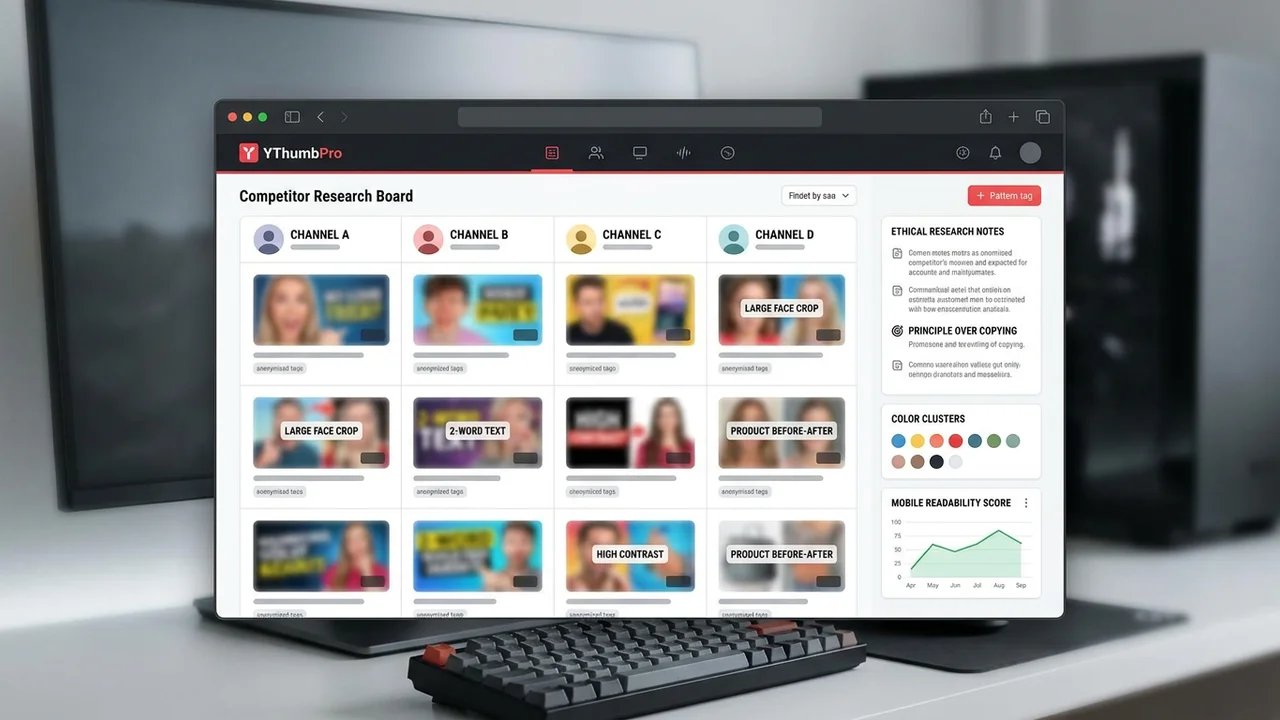
A pattern is a general design move: large face crop, two-word text, high contrast, or product-before-after framing.
Copying is reusing another creator's image, layout, branding, or protected artwork. Keep the principle and make your own expression.
Turn notes into your next thumbnail
After the audit, write three decisions: what the category expects, what your channel should repeat, and where you will differentiate.
Use YThumbPro analysis to check whether the resulting candidate is readable and coherent before publishing.
Choose competitors with the same viewer job
Competitor thumbnail analysis works best when the comparison set is narrow. Choose videos that compete for the same viewer job, topic, format, or audience segment. Random viral videos create broad inspiration but weak tactical lessons.
Start with five to ten thumbnails. That is enough to identify repeated patterns without turning research into procrastination. Include a mix of high-performing examples, recent uploads, and videos from channels similar to yours.
The goal is not to copy a competitor. The goal is to learn what the category teaches viewers to expect and where your own channel can fit or stand out.
Tag visible patterns consistently
Use a simple tag set: subject, face crop, text count, color contrast, background complexity, emotional cue, title-thumbnail promise, and series consistency. This gives you comparable notes across examples.
Look for repeated choices. Do top videos use fewer words? Do they show the result instead of the process? Do they rely on faces, objects, before-and-after images, or bold color blocks? Repetition can reveal category norms.
YThumbPro's bulk download workflow page supports this research job by explaining how multiple thumbnails can feed audits, research boards, and creative briefs.
Separate ethical inspiration from copying
Ethical competitor analysis studies principles. Copying reuses another creator's artwork, layout, face, branding, or protected visual assets. The difference matters for trust, originality, and long-term channel identity.
A principle might be: this niche uses two-word text and a large product close-up. Your original execution might use a different product angle, color system, type style, and title promise that fits your video.
Public YThumbPro content repeats this distinction because competitor research pages can attract users who are close to copying. Good SEO should convert them into a responsible workflow.
Turn competitor notes into a creative brief
After the audit, write three short decisions: what the category expects, what your channel should repeat, and where you will differentiate. This turns research into a creative brief instead of a mood board with no conclusion.
For example, you might decide that your niche expects large readable text, but most competitors overuse dark backgrounds. Your differentiated direction could keep the readable text while using a cleaner subject crop and brighter contrast.
Run the resulting candidate through analysis before publishing. The analyzer can check whether your original design still reads clearly and matches the title promise.
Review outcomes after publishing
Competitor research is only useful if it improves your own decisions. After publishing, compare the thumbnail's CTR, retention, and audience response with your notes. Did the adopted pattern help? Did the differentiation stand out? Did the promise match the video?
Over time, build a small channel playbook from those lessons. Keep what works, retire what feels misleading, and refresh old thumbnails that fail the same clarity checks.
This article supports the competitor analysis landing page by showing a complete path: collect examples, tag patterns, build an original candidate, analyze it, publish, and learn from real performance.
Build a small competitor swipe file without copying
A useful swipe file is a labeled research set, not a folder of assets to reuse. Save notes about the pattern: close-up face, two-word text, product result, before-and-after structure, bold color contrast, or no-text curiosity frame.
Add context to each note. Which audience does it serve? What title promise does it support? Is the image a category norm or a differentiator? These questions keep the research strategic instead of decorative.
When you design your own thumbnail, start from the principle and rebuild the execution with original assets. That is how competitor research becomes a creative advantage without becoming imitation.
Use bulk research for channel-level audits
One thumbnail can reveal a tactic. Ten thumbnails can reveal a channel pattern. Bulk research is useful when you need to understand consistency, repeated weaknesses, or how a competitor frames a series over time.
Group examples by topic, format, publish date, and performance goal. Then compare text length, face crop, color, and promise across the set. The goal is to find repeatable decisions, not isolated favorites.
YThumbPro's bulk download page is positioned as a research workflow because channel-level audits need more than a single image. The competitor article gives the method behind that workflow.
How competitor analysis converts into product use
Competitor research often starts as a free download job: collect public thumbnails and inspect them. It becomes a paid workflow when the user needs repeated analysis, saved history, comparison notes, and structured review across many examples.
The competitor analysis landing page should therefore link to pricing and analyzer pages, while the article explains the process in enough detail to earn trust before the CTA.
This supports the full SEO/GEO goal: rank for the research query, answer it clearly, help the user act, then invite them into a repeatable analysis workflow when the job becomes serious.
What to capture in competitor notes
For each thumbnail, capture the topic, title promise, visible subject, text length, color strategy, emotional cue, and whether the image depends on a face, object, result, or contrast between two states.
Also note what is missing. Some categories avoid text, some avoid faces, and some rely heavily on product screenshots or proof elements. Absences can be as informative as repeated features.
The output should be a short set of decisions your team can use: what to match, what to avoid, and what original angle to test next.
How to compare against your own channel
Place competitor thumbnails beside your own thumbnails from similar topics. Ask whether your image is easier to understand at mobile size, whether the title-thumbnail promise is clearer, and whether your focal point is stronger.
If competitors consistently use a pattern that your channel ignores, decide whether that pattern is a category expectation or an opportunity to differentiate. Both answers can be useful.
Use analysis on your own candidate, not just the competitor image. The goal is to improve your thumbnail while preserving original assets and your channel's identity.
From research board to publishable candidate
A research board is only the input. The next step is an original candidate that uses your own visuals, your own promise, and your own channel positioning. The competitor set should inform the brief, not become the design.
After creating the candidate, compare it against the research notes. Does it satisfy the category's basic expectations? Does it have one clear differentiator? Does it still read on mobile?
This final step is where YThumbPro's analyzer and A/B test pages connect naturally. Research informs the candidate, analysis improves it, and later performance data tells you what to keep.
A competitor analysis worksheet
A simple worksheet can keep research consistent. Use columns for video URL, topic, title promise, thumbnail subject, text count, color system, emotional cue, focal point, likely reason it works, and one original idea it inspires.
Do not score competitors only by whether you like the image. Instead, ask what viewer problem the thumbnail solves. Does it make a result obvious? Does it clarify a comparison? Does it make a conflict visible? Does it promise a concrete transformation?
After the worksheet is complete, summarize the pattern in plain language. For example: successful videos in this topic use one product close-up, fewer than four words, and a visible before-and-after contrast. That summary is the useful output.
Turn research into a channel rule
A channel rule is a repeatable design decision based on evidence. It might say tutorial thumbnails need one large UI result, or review thumbnails need the product and verdict visible together. The rule should be specific enough to guide a future design.
Test the rule on your next candidate, then review the result after publishing. If the rule helps clarity and performance, keep it. If it makes your channel look generic, revise the rule around differentiation.
This is where competitor analysis becomes a growth workflow. The user starts by downloading public thumbnails, then uses structured analysis to build original thumbnails that fit their audience and business goals.
Mistakes that weaken competitor research
The first mistake is collecting examples from unrelated niches. A viral entertainment thumbnail may teach little to a finance, education, or product-review channel. Keep the research set close to the viewer job your video must satisfy.
The second mistake is copying the visible style without understanding the promise. A color palette, face crop, or text format only works when it supports the topic and audience expectation.
The third mistake is stopping at inspiration. The research should end with an original candidate, a reason for that candidate, and a plan to analyze or test it. Otherwise the work creates a mood board but no measurable improvement.
Next action
Turn this research into a repeatable thumbnail workflow
When thumbnail review becomes part of your publishing routine, compare the plan that matches saved history, repeated analysis, and testing needs.
Step-by-step guide
- 1
Pick a narrow topic
Choose similar videos from channels competing for the same viewer job.
- 2
Collect thumbnails
Save public examples into a small research board.
- 3
Tag visible patterns
Mark text, subject, contrast, expression, and promise.
- 4
Create your own candidate
Apply the principle with original imagery and analyze it before publishing.
Frequently asked questions
Is competitor thumbnail analysis ethical?
Yes when you study public patterns and create original assets. Do not copy another creator's artwork or branding.
How many competitor thumbnails should I collect?
Start with five to ten from the same topic or format.
Can AI analyze competitor thumbnails?
AI can help summarize visible readiness signals, but the final strategy should come from your channel context.