How AI Scores YouTube Thumbnail CTR Readiness
Understand how AI thumbnail scoring reviews mobile readability, focal clarity, contrast, expectation match, and click motivation without pretending to predict exact CTR.
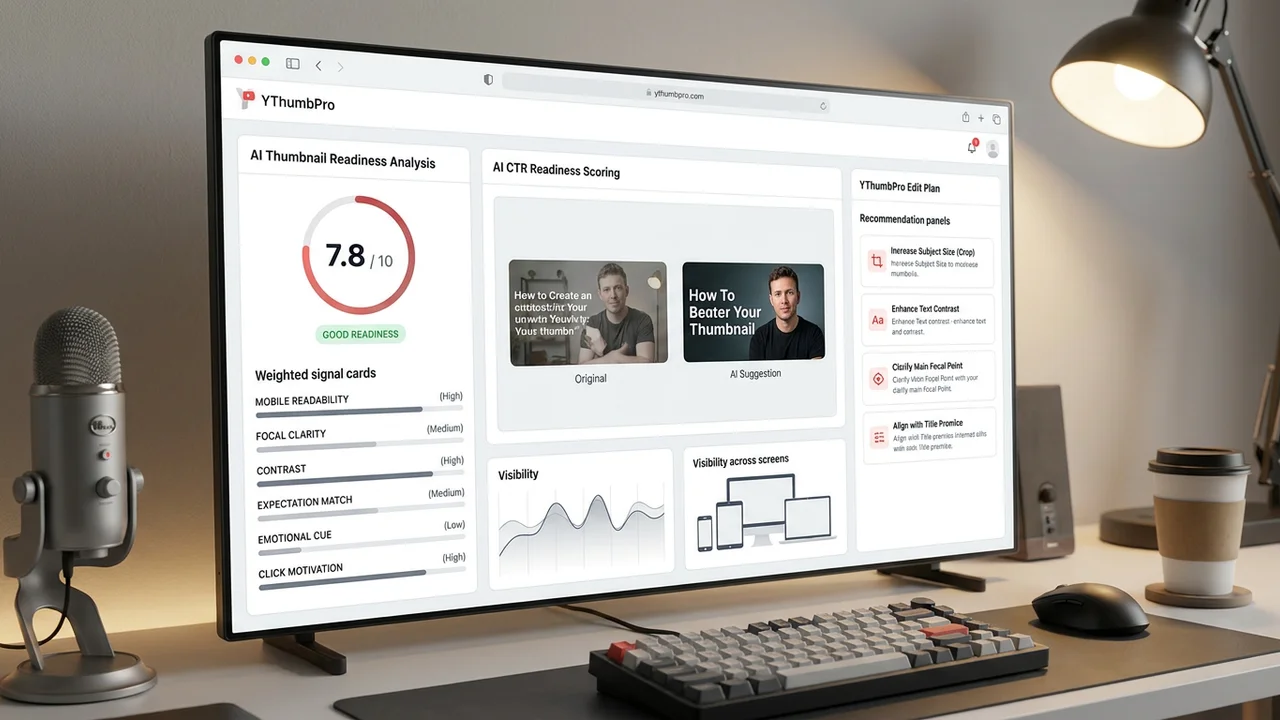
Direct answer
AI can score YouTube thumbnail CTR readiness by reviewing visible signals that often influence clicks: mobile readability, focal clarity, contrast, expectation match, emotional cue, and click motivation. It cannot know exact future CTR because YouTube performance also depends on title, topic, audience, timing, and traffic source.
Key takeaways
- AI scoring is a readiness review, not a CTR forecast.
- The useful output is an edit plan tied to visible thumbnail signals.
- Real YouTube Analytics should validate important thumbnail decisions after publishing.
AI readiness score vs live YouTube metrics
| Signal | What it can tell you | What it cannot prove |
|---|---|---|
| AI readiness score | Visible risks before publishing | Exact future CTR |
| YouTube CTR | Actual clicks from impressions | Why the thumbnail won or lost by itself |
| Retention | Whether the click matched the video | Thumbnail quality alone |
| A/B result | Relative performance with enough traffic | Universal winning design rules |
Why AI scoring starts with visibility
A thumbnail is judged quickly and often at small size. That makes visibility the first scoring layer. If the subject, text, or product cannot be understood on a phone, other creative details usually matter less.
YThumbPro's scoring language focuses on visible readiness signals because those are the parts a creator can change before publishing. The score is useful when it points to a concrete edit, such as larger text, a tighter crop, or stronger subject separation.
What expectation match means
Expectation match asks whether the thumbnail promise and title promise describe the same video. A thumbnail can attract a click and still create a weak outcome if the viewer feels misled after the first few seconds.
This is why CTR readiness should not reward pure clickbait. A stronger thumbnail makes the right viewer curious about the actual video, which can support both click-through and retention.
Why exact CTR prediction is not honest
CTR depends on more than the image. Topic demand, title strength, traffic source, recommendation context, upload timing, audience relationship, and competing videos all affect the result.
A credible AI checker should explain uncertainty. It can say a thumbnail is easier to read, more focused, or more aligned with the title. It should not claim that a visible score guarantees a specific percentage in YouTube Analytics.
How to use the score in a real workflow
Use the first score to find the weakest visible dimension. Revise one or two high-impact areas, then re-analyze the new candidate. Compare the reasoning, not just the number.
After the video has impressions, compare the AI recommendation with real performance. If the thumbnail won clicks but hurt retention, revise the promise. If it lost clicks but retention was strong, test clearer packaging without changing the video idea.
Next action
Turn this research into a repeatable thumbnail workflow
When thumbnail review becomes part of your publishing routine, compare the plan that matches saved history, repeated analysis, and testing needs.
Step-by-step guide
- 1
Load the thumbnail
Start from a public YouTube URL or the candidate image you plan to publish.
- 2
Read the score dimensions
Identify the weakest visible signal instead of reacting only to the total score.
- 3
Make one focused edit
Improve text size, focal clarity, contrast, or title-thumbnail alignment.
- 4
Re-score the candidate
Compare the revised image against the original and review the explanation.
- 5
Validate after publishing
Use YouTube CTR and retention data to decide whether the thumbnail actually helped.
Frequently asked questions
Can AI predict exact YouTube CTR?
No. AI can review readiness signals, but exact CTR depends on YouTube distribution, audience, title, topic, and timing.
What does a thumbnail CTR checker score?
It should score visible signals such as mobile readability, focal clarity, contrast, expectation match, and click motivation.
Should I trust AI more than YouTube Analytics?
Use AI before publishing and Analytics after the video has enough impressions. They answer different questions.