YouTube Thumbnail A/B Testing Guide
How to compare YouTube thumbnail candidates, use AI pre-test feedback, and interpret live thumbnail performance without overclaiming certainty.
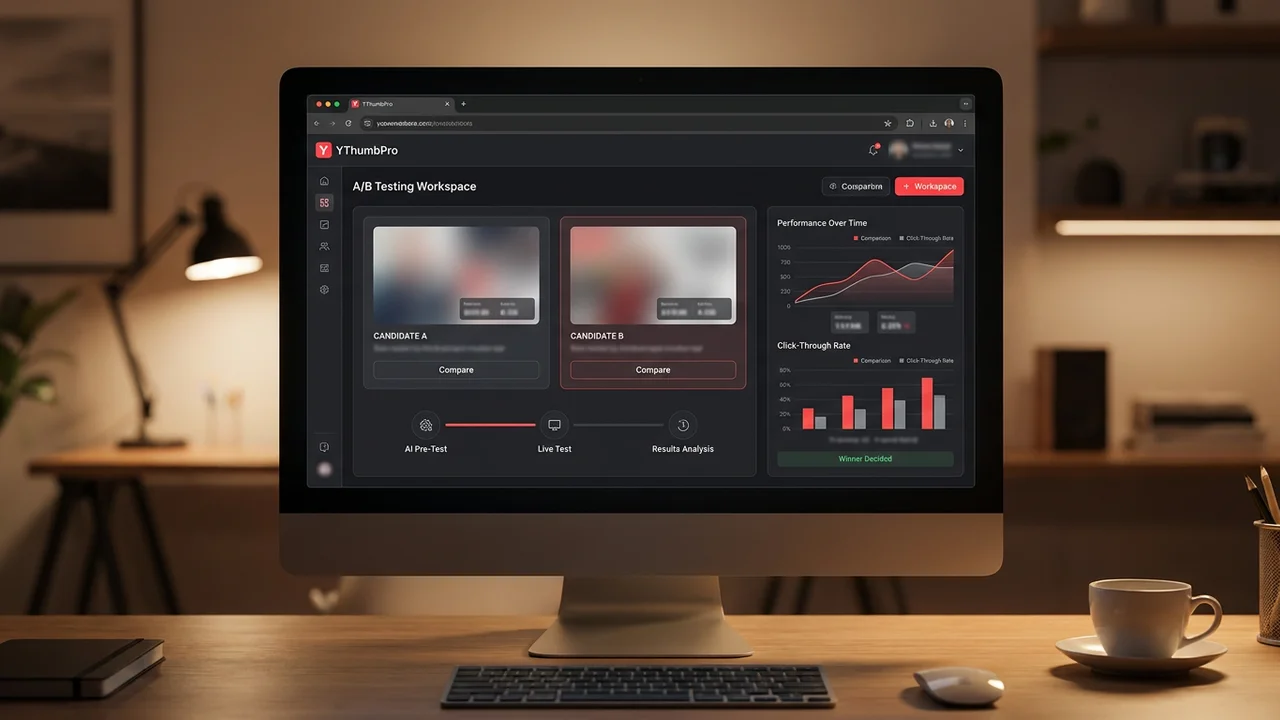
Direct answer
YouTube thumbnail A/B testing compares two thumbnail candidates for the same video. Use AI pre-test feedback to remove weak options before publishing, then rely on real YouTube performance data when you need audience-measured results.
Key takeaways
- Compare one clear thumbnail direction at a time.
- AI pre-tests are useful filters, not audience data.
- Live results need enough impressions to be meaningful.
Pre-test and live test differences
| Testing layer | Best use | Main limitation |
|---|---|---|
| AI pre-test | Fast quality filter | No audience measurement |
| Team review | Context and taste | Internal bias |
| Live test | Real viewer behavior | Needs traffic and time |
| Post-publish review | Refresh decisions | Only after performance data exists |
Build a fair comparison
A fair thumbnail test keeps the same video idea and title context while changing one meaningful visual direction.
If every element changes at once, the result may still be useful, but it becomes harder to learn which signal mattered.
Use AI before spending live traffic
Pre-test analysis helps catch weak readability, unclear focal points, or mismatch before viewers ever see the candidate.
This is especially useful for creators who do not have enough traffic to test every idea live.
Interpret live results carefully
A better CTR is useful only when it attracts the right viewer and does not harm retention.
Review impressions, CTR, traffic source, title context, and watch behavior together before declaring a winner.
Define what you are testing
A useful thumbnail A/B test starts with a clear question. Are you testing a face versus no face, short text versus no text, a product close-up versus a result image, or a calmer design versus a more emotional one?
If every part of the thumbnail changes at once, the test may still find a winner, but it will teach less. A focused test makes the next decision easier because you know which visual direction probably mattered.
For creators without enough traffic for many live tests, this discipline matters even more. Every candidate should be strong enough to deserve impressions before it reaches the audience.
Use AI pre-tests to remove weak candidates
AI pre-testing is useful before live testing because it can identify obvious problems quickly: small text, unclear focus, low contrast, weak promise, or a mismatch between image and title.
Treat the AI output as a quality filter. It can help decide which candidate needs revision, but it does not replace audience data. A thumbnail that scores well still needs to perform with real viewers.
YThumbPro's A/B test landing page is honest about this distinction. It frames the product as a pre-test and comparison workflow rather than claiming to run a live YouTube experiment.
Interpret live tests with enough context
When a thumbnail is live, CTR should be read with impressions, traffic source, audience segment, title, and retention. A candidate that wins CTR but hurts retention may be attracting the wrong click.
Avoid declaring a winner too early. Low impression counts can make results noisy, especially on small channels. Look for directional consistency before making the lesson part of your channel style.
A good post-publish review asks why the result happened. Did the winning thumbnail improve readability, clarify the promise, add useful contrast, or simply pair better with the title?
Create a repeatable testing loop
A repeatable loop keeps testing from becoming random taste debate. Collect two candidates, run pre-test analysis, revise the weak points, publish the stronger option, then review real performance after enough impressions.
Save notes on what changed. Over time, those notes become a channel-specific thumbnail playbook. You may learn that your audience responds to certain framing, text length, facial expression, or result imagery.
YThumbPro supports this loop by connecting downloader, analyzer, A/B test, CTR glossary, and methodology pages. The SEO structure mirrors the creator workflow from image retrieval to performance learning.
Know when not to test
Not every video needs a formal thumbnail test. If the topic is low-stakes, the channel is early, or the video will not receive enough impressions, a simple readiness review may be enough.
Use deeper testing for videos with commercial value, evergreen search potential, strong audience fit, or a history of underperforming despite good content. Those are the cases where a better thumbnail can meaningfully affect outcomes.
This framing helps the A/B article support conversion: casual users can use the free downloader, while serious creators see why repeated analysis and saved comparison workflows are worth an account.
Design a test that teaches something
A useful test changes one meaningful idea at a time. For example, compare a face-led thumbnail against a result-led thumbnail, or compare a text-heavy version against a cleaner visual promise. Avoid changing the topic framing, title, color system, and focal point all at once unless the only goal is to pick a winner.
Write the hypothesis before the test: this version should win because the subject is clearer on mobile, or this version should win because the promise is more specific. The written hypothesis makes the result easier to learn from.
Even if the audience test is run elsewhere, YThumbPro can help before the test by scoring visible readiness and after the test by documenting why the winner may have worked.
Avoid common A/B testing traps
Do not test weak candidates just because they are different. A weak test wastes impressions and teaches little. Use AI pre-test feedback and human judgment to bring both candidates to a minimum quality bar first.
Do not read small samples as certainty. Thumbnail results can shift by traffic source, day, title, audience, and recommendation context. A winner on browse traffic may not be the same winner in search.
Do not ignore retention. If one thumbnail increases CTR but attracts viewers who leave early, the better business decision may be the more accurate thumbnail.
How the A/B guide supports the commercial page
The A/B test landing page targets users looking for a tool. This guide supports that page by teaching the workflow behind the tool: define the hypothesis, compare candidates, pre-test with AI, run or observe live behavior, and document the lesson.
Internal links to the analyzer, CTR guide, and methodology help users see why repeated analysis can justify signup or a paid plan. The value is not a single score; it is the repeatable comparison process.
For AI search, the article's direct answer, table, ordered steps, FAQ, and sources make it easier to extract a balanced summary that does not overclaim live testing capability.
Pre-test scoring versus real experiments
Pre-test scoring is fast and cheap. It helps identify whether a candidate has obvious visual weaknesses before it reaches viewers. Real experiments are slower but more authoritative because they measure actual audience behavior.
Creators should use both when the stakes justify it. Use AI to improve candidates before live exposure, then use YouTube performance data to validate whether the better-looking candidate actually wins with viewers.
This distinction keeps the page honest. YThumbPro can support comparison and readiness review without pretending to own YouTube's live testing environment.
What to save after every test
Save the two thumbnail files, the title used during the test, the analysis notes, the publish date, the traffic source context, and the eventual performance result. Without those notes, the team may remember the winner but forget the lesson.
A small log helps creators build a channel-specific playbook. Over time, you can identify whether your audience responds to faces, proof, product close-ups, short text, emotional cues, or cleaner minimal designs.
Saved history is one reason repeated analysis can become a paid workflow. The value compounds when each test teaches the next thumbnail.
Use A/B testing for important decisions
Formal testing is most useful for videos with durable search demand, high monetization potential, sponsor value, or a history of good content underperforming because of packaging.
For lower-stakes videos, a quick analyzer pass and human review may be enough. That keeps the process lightweight while preserving deep testing for moments where it can change business outcomes.
This business framing supports the SEO objective. The page does not only attract visitors; it explains when a user should move from free utility into account-based and paid optimization workflows.
A thumbnail test planning template
Before comparing candidates, write a short plan: video title, target viewer, candidate A promise, candidate B promise, one visual difference, expected winner, and why that winner should work. This plan makes the result easier to interpret later.
For example, candidate A might use a close-up face because the video depends on emotion, while candidate B might show the final result because the video depends on proof. That is a meaningful comparison. Randomly changing every detail is not as useful.
Run the candidates through a pre-test analyzer before the live decision. If one candidate has obvious readability or expectation-match issues, revise it before the comparison. A/B testing should compare strong options, not one finished design against one broken draft.
How to communicate results to a team
When sharing results, report the context with the winner. Include impressions, traffic source, CTR, retention notes, title, publish timing, and the main visual difference. Without context, a result can be overgeneralized into a bad rule.
A team should avoid saying faces always win or red always wins from one test. A better conclusion is narrower: for this topic type and audience, a larger face crop helped viewers understand the conflict faster.
Those narrower lessons compound into a useful thumbnail playbook. They also explain why saved analysis history and repeated comparison workflows can become valuable beyond a single free download.
What a strong pre-test report includes
A strong pre-test report should show the two candidates, the title context, the main visual difference, the analyzer notes, and the final recommendation. The report does not need to be long, but it should be specific enough that another teammate understands the choice.
Include the reason for rejecting the weaker candidate. Was the text too small, the focal point unclear, the contrast weak, or the promise mismatched? That reason becomes a reusable lesson for the next thumbnail.
This report format is also useful for agencies and channel teams. It turns A/B testing from a casual preference vote into a documented packaging decision that can be reviewed after performance data arrives.
Next action
Turn this research into a repeatable thumbnail workflow
When thumbnail review becomes part of your publishing routine, compare the plan that matches saved history, repeated analysis, and testing needs.
Step-by-step guide
- 1
Choose two candidates
Keep the video and title context constant.
- 2
Run pre-test analysis
Score each candidate and read the reasons.
- 3
Pick the strongest option
Use the better candidate or revise the weak one.
- 4
Measure live behavior
Review CTR and retention once the video has impressions.
Frequently asked questions
Can YThumbPro run a live A/B test?
YThumbPro supports pre-test analysis and comparison workflows; live audience tests still depend on YouTube or other testing systems.
How many thumbnails should I compare?
Start with two strong candidates. More variants can make the decision harder unless you have enough traffic.
Should I trust AI or live data?
Use AI before publishing and live data after enough impressions exist.