YouTube Thumbnail 4K Download: 2026 Quality Checks
YouTube thumbnail 4K download guide with max resolution checks, honest HD fallbacks, source notes, and creator-safe reuse before saving. Try it now.
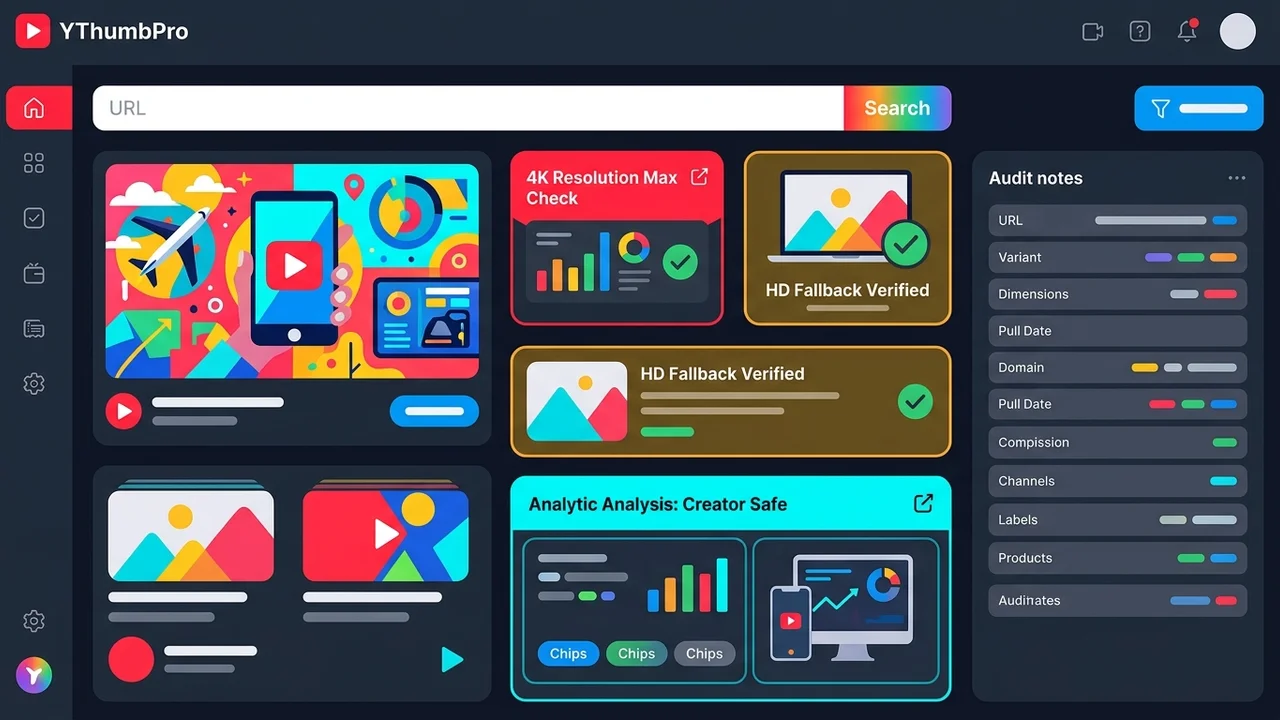
Direct answer
A YouTube thumbnail 4K download workflow should start by checking the largest public thumbnail variant, usually maxresdefault, then verify whether the file actually loads before saving it. Most public YouTube thumbnails are not true 4K source exports, so the safest workflow is to label real HD fallbacks clearly and keep source notes for audits, briefs, or thumbnail refresh decisions.
Key takeaways
- 4K is a search shortcut, but most public thumbnails resolve to maxresdefault or an HD fallback.
- Verify the largest real image that loads before using it in a design review or creator audit.
- Do not upscale a smaller fallback and present it as a true 4K thumbnail download.
- Save the video URL, variant, dimensions, and pull date beside any thumbnail used for decisions.
Published: 2026-06-05 Last updated: 2026-07-04 Author: jackyi Reviewed by: YThumbPro editorial review
AI-assisted writing disclosure: this article was drafted with AI assistance and reviewed for accuracy, originality, and YThumbPro product fit by the YThumbPro editorial team.
youtube thumbnail 4K download searches usually mean one practical thing: you want the cleanest public thumbnail file without fake quality labels, blurry screenshots, or upscaled fallbacks. This updated youtube thumbnail 4K download guide shows the workflow I use for YThumbPro audits: test the largest real public variant, verify what actually loads, label HD fallbacks honestly, and save evidence notes for later review.
A YouTube thumbnail 4K download workflow should start by checking the largest public thumbnail variant, usually maxresdefault, then verify whether the file actually loads before saving it. Most public YouTube thumbnails are not true 4K source exports, so the safest workflow is to label real HD fallbacks clearly and keep source notes for audits, briefs, or thumbnail refresh decisions.
YouTube Thumbnail 4K Download Reality Check
4K is a useful search phrase, but it can be misleading if a downloader treats every thumbnail as a true 4K export. YouTube normally serves public preview images, and the largest common 16:9 variant is often maxresdefault. A reliable youtube thumbnail 4K download page should make that limitation visible before the user saves anything.
That file can be excellent for audits and briefs, but it is not the same as the creator's editable design source. If maxresdefault loads at 1280 x 720, call it the largest public variant instead of pretending it is a 3840 x 2160 source file.
This is the information-gain step I keep in every YThumbPro workflow: quality is not only the pixel label. Quality also means knowing where the file came from, whether it loaded directly, and whether a teammate can trace it later.
YouTube Thumbnail Max Resolution Checks Before Saving
A youtube thumbnail max resolution workflow starts with URL normalization. Watch URLs, Shorts links, mobile share URLs, embed URLs, playlist URLs with a video ID, and raw video IDs should all resolve to the same thumbnail checks.
Use this sequence before saving:
- Copy the public video URL or video ID.
- Paste it into YThumbPro or the 4K thumbnail downloader.
- Test maxresdefault or the largest exposed public variant first.
- Confirm the image loads cleanly and is not a broken placeholder.
- Save the file with source URL, variant, dimensions, and pull date.
If the largest variant fails, use the next available image. The important part is not forcing a bigger label; it is preserving the real result.
YouTube Thumbnail HD Download Fallback Rules
A youtube thumbnail HD download fallback can still be valuable. It just needs an honest label so the next person does not mistake it for a true max-resolution source.
| Result | What it means | Best use |
|---|---|---|
| maxresdefault loads | Largest common public preview image | Audits, briefs, comparison boards |
| sddefault loads | Medium public fallback | Source confirmation, rough quality review |
| hqdefault loads | Smaller public fallback | Fast research, visual pattern notes |
| screenshot only | Captured player view, not source thumbnail | Avoid for source-quality decisions |
| upscaled file | Software-enlarged fallback | Use only if clearly marked as edited |
Do not upscale hqdefault and call it a 4K YouTube thumbnail. Upscaling increases dimensions, but it cannot restore face detail, product edges, text sharpness, or compression that was already lost.
Quality Notes for Creator Audits
When I save thumbnails for creator audits, I write a source note beside each file. The note includes the video URL, variant, visible dimensions, pull date, channel or topic, and intended use.
That small record prevents two expensive mistakes. First, a team does not treat a public preview image as an editable design source. Second, competitor research does not drift into copying another creator's artwork.
For your own channel, pair the saved thumbnail with title, publish date, traffic source, and refresh reason. A file becomes more useful when it supports a decision like "test a cleaner face crop" or "increase mobile text contrast."
When 4K Download Should Become Analysis
Downloading answers "what image can I save?" Analysis answers "does this image help a viewer click?" Those are related, but they are not the same job. That is why a youtube thumbnail 4K download workflow should lead into analysis when the saved image affects a real CTR decision.
Move from download to analysis when the image affects a real publishing decision:
- You are deciding whether an old video needs a thumbnail refresh.
- You are preparing a client audit with visual evidence.
- You are comparing competitor packaging patterns.
- You are checking whether text stays readable at mobile size.
- You are testing whether title promise and thumbnail promise match.
For adjacent workflows, read the YouTube thumbnail max resolution guide, the HD download guide, and the YouTube thumbnail downloader checklist. Then use the YouTube Thumbnail Analyzer when the saved file needs a readability or CTR-focused review.
Conclusion
A youtube thumbnail 4K download workflow should find the largest real public image, verify it before saving, and label fallback files honestly. Start with maxresdefault, avoid fake upscaling claims, and keep source notes so the file can support a real creator audit or refresh decision. That makes youtube thumbnail 4K download work repeatable instead of guesswork.
Ready to test one? Use YThumbPro, open the 4K downloader, or compare a saved image with the YouTube Thumbnail Analyzer.
Frequently Asked Questions
Q: Can I download a YouTube thumbnail in true 4K?
Usually no. YouTube commonly exposes public thumbnail variants such as maxresdefault rather than the creator's original 4K design export, so verify the real loaded file before calling it 4K.
Q: What is the best 4K YouTube thumbnail download workflow?
Paste the public video URL into a downloader, test maxresdefault first, verify that the image loads, then save the largest real variant with source notes.
Q: Why does maxresdefault sometimes fail?
The video may be old, private, removed, low resolution, a Short, or missing a large custom thumbnail. In that case, use the next available public image and label it as a fallback.
Q: Is an HD fallback useful if 4K is unavailable?
Yes. A clear HD fallback can support research, audits, and briefs, but it should not be described as a true 4K file or editable source artwork.
About the Author
jackyi is a YouTube growth and thumbnail optimization practitioner focused on practical creator workflows. YThumbPro articles are written with AI assistance, edited for originality, and reviewed against product behavior before publication.
Next action
Use this guide on a real YouTube thumbnail
Paste a video URL, download the available thumbnail sizes, then decide whether the image needs a deeper AI readiness review.
Step-by-step guide
- 1
Copy the public video URL
Use a watch URL, Shorts URL, mobile share link, embed URL, playlist URL with a video ID, or a raw 11-character video ID.
- 2
Open the 4K or HD downloader
Paste the link into YThumbPro so the workflow can normalize the video ID and check available public thumbnail variants.
- 3
Test max resolution first
Try maxresdefault or the largest exposed variant before checking smaller fallback images.
- 4
Verify the loaded file
Confirm the image actually loads, has enough detail for your task, and is not a screenshot or artificial upscale.
- 5
Save with evidence notes
Record the source URL, variant name, visible dimensions, pull date, and intended use beside the downloaded file.
Frequently asked questions
Can I download a YouTube thumbnail in true 4K?
Usually no. YouTube commonly exposes public thumbnail variants such as maxresdefault rather than the creator's original 4K design export, so verify the real loaded file before calling it 4K.
What is the best 4K YouTube thumbnail download workflow?
Paste the public video URL into a downloader, test maxresdefault first, verify that the image loads, then save the largest real variant with source notes.
Why does maxresdefault sometimes fail?
The video may be old, private, removed, low resolution, a Short, or missing a large custom thumbnail. In that case, use the next available public image and label it as a fallback.
Is an HD fallback useful if 4K is unavailable?
Yes. A clear HD fallback can support research, audits, and briefs, but it should not be described as a true 4K file or editable source artwork.